8.2 - Refrigerant Pressure Classifications
Module: Type II High and Very-High-Pressure Appliances
Regulatory verification date: August 12, 2026
Primary authority: Current 40 CFR §§ 82.152 and 82.161 and current EPA Section 608 test-topic guidance
Course role: Defines the low-, medium-, high-, and very-high-pressure appliance categories used in Section 608 and explains how refrigerant identification, saturation pressure, and equipment information are used to select the correct certification category
Learning Objectives
After completing this section, a student should be able to:
- Define the current EPA low-, medium-, high-, and very-high-pressure appliance categories.
- Explain why the classification is based on refrigerant properties, not on a momentary operating gauge pressure.
- Use the refrigerant identified on an equipment nameplate together with the current Section 608 definitions to determine the applicable pressure category.
- Distinguish psia from psig and explain why the Section 608 pressure-category definitions use absolute pressure.
- Identify representative refrigerants in each current pressure category and connect medium-, high-, and very-high-pressure appliances to Type II certification.
- Recognize outdated pressure-category terminology and avoid applying older labels to current Section 608 classification questions.
Introduction
Type II certification is commonly described as the high-pressure certification. That shorthand is useful, but it is incomplete.
Under the current Section 608 regulation, Type II certification covers covered work on:
- Medium-pressure appliances.
- High-pressure appliances.
- Very-high-pressure appliances.
Low-pressure appliances belong to Type III, while small appliances meeting the Type I definition remain Type I even when the refrigerant itself would otherwise fall within a Type II pressure category.
The key to this classification is that EPA does not classify an appliance by the pressure shown on a service gauge while the system is operating. Instead, the regulatory definitions use a refrigerant property: its liquid-phase saturation pressure at , with an additional critical-temperature criterion for very-high-pressure appliances.
This distinction matters because every ordinary vapor-compression system has a high side and a low side during operation. A system classified by EPA as a low-pressure appliance still has an operating high side, and a system classified as a high-pressure appliance still has an operating low side.
Therefore:
Operating high side / low side
≠
EPA appliance pressure classification
The purpose of this section is to make the regulatory pressure categories precise before later Type II sections introduce leak detection, recovery, evacuation, compressor service, and safety requirements.
Key Concepts
1. EPA Uses Four Appliance Pressure Categories
Current Section 608 definitions divide appliances into four pressure categories:
| Pressure Category | Current Regulatory Classification Basis | Representative Refrigerants Named in the Current Regulation | Section 608 Certification Direction |
|---|---|---|---|
| Low pressure | Liquid-phase saturation pressure below 45 psia at | R-11, R-113, R-123, R-245fa | Type III |
| Medium pressure | Liquid-phase saturation pressure between 45 psia and 170 psia at | R-12, R-114, R-124, R-134a, R-500 | Type II |
| High pressure | Liquid-phase saturation pressure between 170 psia and 355 psia at | R-22, R-407A, R-407C, R-410A, R-502 | Type II |
| Very high pressure | Critical temperature below , or liquid-phase saturation pressure above 355 psia at | R-13, R-23, R-503, R-508A, R-508B | Type II |
The refrigerants listed are examples, not complete lists.
The most important certification relationship is:
Low pressure
→ Type III

Medium pressure
→ Type II

High pressure
→ Type II

Very high pressure
→ Type II
This current regulatory relationship is more precise than the simplified label Type II - High-Pressure used on many examination-preparation pages.
2. The Reference Condition Is
The pressure-category definitions use the refrigerant’s liquid-phase saturation pressure at .
This does not mean that:
- The appliance normally operates at .
- The evaporator must be at .
- The condenser must be at .
- The technician should heat a system to to identify its certification type.
Instead, is a common regulatory reference temperature used to compare refrigerants on the same basis.
The logic is:
Identify refrigerant
→ determine its saturation-pressure classification at 104°F
→ determine the EPA pressure category
→ apply the appropriate certification category
For most examination questions, the refrigerant or appliance category will be identifiable without calculating a saturation pressure from first principles. The student should nevertheless understand what the classification means.
3. Saturation Pressure Is a Refrigerant Property
When liquid and vapor of a pure refrigerant coexist in equilibrium, pressure and saturation temperature are related.
For a given refrigerant:
Higher saturation temperature
→ higher saturation pressure
The Section 608 pressure categories use this thermodynamic relationship as a standardized way to group refrigerants.
A pressure-temperature chart is therefore useful because it connects:
- Refrigerant identity.
- Saturation temperature.
- Saturation pressure.
However, a P-T chart is a reference tool, not a substitute for reading the equipment nameplate and identifying the actual refrigerant in the appliance.
Detailed pressure-temperature chart use was introduced in Section 4.7 - Pressure-Temperature Relationships.
4. The Regulatory Pressure Is Absolute Pressure
The current regulatory definitions use psia, or pounds per square inch absolute.
Absolute pressure is measured relative to a perfect vacuum.
Gauge pressure, psig, is measured relative to local atmospheric pressure.
Near standard atmospheric conditions:
Using the commonly assumed standard atmospheric pressure of approximately :
EPA’s current Type II test-topic guidance specifically reminds candidates that a standard pressure-temperature chart may show psig, while regulatory or thermodynamic comparisons may require psia.
Example
If a pressure-temperature chart shows a saturation pressure of approximately at the reference temperature, the corresponding absolute pressure is approximately:
That value lies within the current high-pressure range.
Exam reminder: Do not compare a psig value directly with a definition stated in psia without accounting for atmospheric pressure.
5. Operating Gauge Pressure Does Not Define the Category
A common mistake is to connect a service gauge, observe the pressure, and then try to classify the appliance from that operating reading.
That is not the regulatory method.
Operating pressures vary with:
- Indoor temperature.
- Outdoor temperature.
- Evaporator load.
- Condenser load.
- Airflow.
- Water flow.
- Refrigerant charge.
- Compressor condition.
- Metering-device operation.
- Heat-pump operating mode.
The regulatory classification remains based on the refrigerant property at the defined reference condition, not on one field gauge reading.
Therefore:
Observed suction pressure
≠ pressure-category definition
and:
Observed discharge pressure
≠ pressure-category definition
The appliance does not move from one EPA pressure category to another because the weather changes or because the compressor cycles on and off.
6. High Side and Low Side Are Different Concepts
Within an operating vapor-compression system:
- The high side extends generally from the compressor discharge through the condenser to the metering-device inlet.
- The low side extends generally from the metering-device outlet through the evaporator to the compressor suction.
Those terms describe locations within the refrigeration cycle.
By contrast:
- Low-pressure appliance.
- Medium-pressure appliance.
- High-pressure appliance.
- Very-high-pressure appliance.
are EPA appliance classifications.
A Type II high-pressure split system still has both:
- A high side.
- A low side.
A Type III low-pressure chiller also has different pressure regions during operation.
The categories must not be confused.
Detailed cycle-side terminology was developed in Section 4.3 - High Side Low Side and Refrigerant Lines.
7. Medium-Pressure Appliances Are Part of Type II
This is one of the most important current-regulation distinctions in Module 8.
The current technician-certification regulation states that persons performing covered work on medium-, high-, or very-high-pressure appliances within the Type II scope must be certified as Type II technicians.
Representative medium-pressure refrigerants named in the current definition include:
- R-12.
- R-114.
- R-124.
- R-134a.
- R-500.
Therefore, this shortcut is incorrect:
Type II = only refrigerants between 170 and 355 psia at 104°F
The correct regulatory relationship is:
Type II = medium + high + very-high pressure
subject to the appliance exclusions and special cases already developed in Section 8.1.
8. High-Pressure Appliances Include Common Type II Refrigerants
Representative refrigerants named in the current high-pressure definition include:
- R-22.
- R-407A.
- R-407C.
- R-410A.
- R-502.
Many familiar residential and commercial Type II systems use or historically used refrigerants in this group.
For examination preparation, remember that R-410A is a high-pressure refrigerant under the current Section 608 definition, not a very-high-pressure refrigerant merely because its operating pressures are substantially higher than those of R-22.
This is a useful example of why colloquial phrases such as “very high pressure” must not replace the regulatory definition.
9. Very-High-Pressure Appliances Have an Additional Criterion
The very-high-pressure definition is different from the other three because it uses two alternative criteria.
A very-high-pressure appliance uses a refrigerant that has either:
- A critical temperature below , or
- A liquid-phase saturation pressure above 355 psia at .
Representative examples named in the current regulation include:
- R-13.
- R-23.
- R-503.
- R-508A.
- R-508B.
Very-high-pressure systems are less common in ordinary residential HVAC work, but they remain within Type II certification and can appear in Section 608 examination material.
10. Low-Pressure Appliances Are Type III, Not Type II
A low-pressure appliance uses a refrigerant with a liquid-phase saturation pressure below 45 psia at .
Representative examples named in the current regulation include:
- R-11.
- R-113.
- R-123.
- R-245fa.
These appliances fall under Type III, not Type II.
Low-pressure appliances deserve separate treatment because many operate below atmospheric pressure during normal operation. As a result, air and moisture can leak into the appliance rather than refrigerant always leaking outward.
Module 9 develops the specialized Type III procedures.
11. Read the Equipment Nameplate First
The equipment nameplate is one of the most important field sources for refrigerant identification.
Depending on the equipment, the nameplate or manufacturer label may provide:
- Refrigerant designation.
- Factory refrigerant charge.
- Electrical data.
- Model number.
- Serial number.
- Design or test pressures.
- Safety or certification markings.
For pressure-category classification, the technician should use the nameplate primarily to answer:
What refrigerant is this appliance designed to contain?
Then classify that refrigerant using current authoritative pressure-category information.
Do not use a nameplate’s design pressure, maximum allowable working pressure, or test pressure as though it were the Section 608 saturation-pressure classification value.
These are different concepts.
| Nameplate Item | What It Tells the Technician | Does It Directly Define the EPA Pressure Category? |
|---|---|---|
| Refrigerant designation | Which refrigerant the appliance is designed to use | Use this to identify the refrigerant, then classify it |
| Factory charge | Refrigerant quantity installed or specified by manufacturer | No |
| Design pressure / test pressure | Mechanical pressure rating or test condition | No |
| Model and serial number | Equipment identification | No |
| Electrical rating | Electrical operating requirements | No |
12. Never Identify Refrigerant From Cylinder Color or Guesswork
Pressure classification begins with correct refrigerant identification.
Do not determine refrigerant identity only from:
- Cylinder color.
- Hose color.
- Equipment age.
- Compressor size.
- Typical application.
- A single pressure reading.
Use reliable identification sources such as:
- Equipment nameplate.
- Manufacturer service information.
- Service records.
- Refrigerant identifier when appropriate.
- Verified pressure-temperature relationship as supporting evidence.
Refrigerant identification was developed in Section 3.4 - Refrigerant Identification.
13. A Refrigerant Family Does Not Determine the Pressure Category
Chemical family and pressure category answer different questions.
For example:
- R-12 is a CFC and is listed as medium pressure.
- R-22 is an HCFC and is listed as high pressure.
- R-134a is an HFC and is listed as medium pressure.
- R-410A is an HFC blend and is listed as high pressure.
- R-123 is an HCFC and is listed as low pressure.
Therefore:
CFC / HCFC / HFC / HFO family
≠
low / medium / high / very-high pressure category
Chemical composition, ozone-depletion potential, global-warming potential, safety classification, and pressure classification are separate characteristics.
14. Newer Refrigerants Must Be Classified From Current Information
The regulatory examples are not a complete list of every refrigerant used in modern equipment.
When a refrigerant is not specifically named in a study table:
- Identify the refrigerant accurately.
- Use current manufacturer or authoritative refrigerant-property information.
- Determine the applicable Section 608 pressure category from the current regulatory definition.
- Confirm whether another appliance category or exemption controls.
Do not assume that a newer refrigerant belongs in the same pressure category as the refrigerant it replaces.
15. Appliance Classification Still Comes Before a Simple Pressure Shortcut
Knowing the refrigerant pressure category is necessary, but it is not always sufficient to determine the technician certification.
The classification sequence remains:
1. Identify the equipment and refrigerant.
↓
2. Check whether the equipment is an MVAC or MVAC-like appliance.
↓
3. Check whether it satisfies the Type I small-appliance definition.
↓
4. Determine the refrigerant pressure category.
↓
5. Low pressure → Type III.
   Medium / high / very high → Type II.
For example, a factory-sealed small appliance may contain a refrigerant that falls within a medium- or high-pressure refrigerant category, but Type I still controls the maintenance, service, and repair certification because the appliance satisfies the small-appliance definition.
This is why refrigerant pressure alone must not replace the complete equipment-classification process.
Technical and Regulatory Details
1. Current Regulatory Definitions
The current definitions can be summarized as follows.
Low-Pressure Appliance
A low-pressure appliance uses a refrigerant whose liquid-phase saturation pressure is below at .
Representative current regulatory examples:
- R-11.
- R-113.
- R-123.
- R-245fa.
Certification direction:
Type III
Medium-Pressure Appliance
A medium-pressure appliance uses a refrigerant whose liquid-phase saturation pressure falls between and at .
Representative current regulatory examples:
- R-12.
- R-114.
- R-124.
- R-134a.
- R-500.
Certification direction:
Type II
High-Pressure Appliance
A high-pressure appliance uses a refrigerant whose liquid-phase saturation pressure falls between and at .
Representative current regulatory examples:
- R-22.
- R-407A.
- R-407C.
- R-410A.
- R-502.
Certification direction:
Type II
Very-High-Pressure Appliance
A very-high-pressure appliance uses a refrigerant with either:
- A critical temperature below , or
- A liquid-phase saturation pressure above at .
Representative current regulatory examples:
- R-13.
- R-23.
- R-503.
- R-508A.
- R-508B.
Certification direction:
Type II
2. Why Absolute Pressure Matters
The regulatory threshold values are stated in psia.
A service gauge normally displays psig.
Near standard atmospheric conditions:
Likewise:
A student should therefore always check the pressure unit before comparing a P-T chart value with a regulatory definition.
Why This Can Cause an Exam Error
Suppose a question provides:
- A pressure-category threshold in psia.
- A P-T chart in psig.
If the candidate compares the numbers directly, the result can be wrong by approximately one atmosphere.
The unit label is part of the question.
3. Pressure Classification Versus Equipment Design Pressure
The following terms should remain separate:
| Term | Meaning |
|---|---|
| Saturation pressure at | Refrigerant property used in the Section 608 appliance pressure-category definition |
| Operating suction pressure | Low-side pressure during current system operation |
| Operating discharge/head pressure | High-side pressure during current system operation |
| Design pressure | Pressure used in equipment/component design and rating |
| Test pressure | Pressure specified for a particular equipment or service test |
| Maximum allowable working pressure | Maximum pressure permitted by equipment/component design or code basis |
Only the first item is the classification concept used in the Section 608 definitions discussed here.
4. Pressure Classification Versus Refrigerant Safety Classification
Do not confuse EPA pressure categories with ASHRAE refrigerant safety classes.
Examples of safety-class labels include:
- A1.
- A2L.
- A2.
- A3.
- B1.
- B2L.
- B2.
- B3.
These describe toxicity and flammability characteristics.
They do not identify whether the appliance is low, medium, high, or very high pressure under Section 608.
Refrigerant safety classification was covered in Section 6.4 - Refrigerant Safety Classifications.
5. Current Type II Wording Versus Public Shorthand
EPA’s public certification materials commonly label the examination category:
Type 2 (High-Pressure)
The current technician-certification regulation is more precise. It requires Type II certification for covered work on:
medium-pressure
+
high-pressure
+
very-high-pressure appliances
This course uses the familiar Type II label while preserving the current regulatory wording whenever classification precision matters.
6. Historical Terminology Found in Older Study Material
Older Section 608 material may use pressure-category names that no longer match the current terminology.
In particular, study guides based on pre-2004 terminology may describe categories differently. A student may encounter older references in which terminology equivalent to today’s medium-pressure group was called high pressure, while terminology equivalent to today’s high-pressure group was called higher pressure.
For this course:
Current regulatory terminology controls.
Do not memorize an old category name merely because it appears in a legacy practice question.
Use this correction rule:
| If an Older Source Uses… | Current Course Action |
|---|---|
| Older pressure-category name | Translate it to the current 40 CFR § 82.152 definition before answering |
| Historical refrigerant list | Verify against current regulation or current candidate information |
| Current-looking pressure number with no unit | Determine whether the source means psia or psig before using it |
| “High pressure” as a broad Type II nickname | Distinguish nickname from the precise current medium/high/very-high definitions |
7. Current Examples Are Examples, Not an Exhaustive Refrigerant List
The current regulation uses phrases such as “examples include but are not limited to.”
Therefore, the refrigerants in the table are teaching anchors, not a complete list.
A new or less-common refrigerant must be classified from:
- Correct refrigerant identification.
- Current thermodynamic property information.
- The current regulatory definition.
- Applicable equipment-category rules.
8. Multiple Refrigerant Circuits
A large piece of equipment can contain more than one independent refrigerant circuit.
For Section 608 purposes, each independent circuit can be considered a separate appliance.
This matters because two circuits in one cabinet can potentially have:
- Different charges.
- Different service histories.
- Different leak conditions.
- Different refrigerants in unusual equipment designs.
The technician should use the specific circuit nameplate and manufacturer information rather than assume every circuit is identical.
9. Field Classification Workflow
A practical classification workflow is:
Step 1 — Read the nameplate.
Identify the refrigerant and equipment/circuit.

Step 2 — Confirm the refrigerant.
Use manufacturer/service information or an identifier when needed.

Step 3 — Check special appliance categories.
Small appliance? MVAC? MVAC-like?

Step 4 — Determine pressure category.
Use the current Section 608 definition and authoritative refrigerant properties.

Step 5 — Select certification direction.
Low pressure → Type III.
Medium/high/very high → Type II.

Step 6 — Apply the later service rule.
Recovery, evacuation, leak repair, or safety requirement depends on the specific task.
Do not skip Step 3. Pressure classification alone does not override the small-appliance or MVAC framework.
Important Terms
Absolute Pressure
Absolute pressure is pressure measured relative to a perfect vacuum. It is commonly expressed in psia. The Section 608 pressure-category definitions use absolute pressure.
Critical Temperature
The critical temperature is the highest temperature at which a substance can exist as a distinct liquid-vapor equilibrium. Above the critical temperature, pressure alone cannot condense the substance into an ordinary liquid phase. The current very-high-pressure appliance definition includes refrigerants with a critical temperature below .
Gauge Pressure
Gauge pressure is pressure measured relative to local atmospheric pressure. It is commonly expressed in psig. HVAC manifold gauges ordinarily display gauge pressure.
High-Pressure Appliance
A high-pressure appliance uses a refrigerant with a liquid-phase saturation pressure between and at . Current examples include appliances using R-22, R-407A, R-407C, R-410A, and R-502.
Liquid-Phase Saturation Pressure
Liquid-phase saturation pressure is the equilibrium pressure corresponding to the saturated liquid-vapor condition at a specified temperature. Section 608 uses the value at as part of the appliance pressure-category definitions.
Low-Pressure Appliance
A low-pressure appliance uses a refrigerant with a liquid-phase saturation pressure below at . Current examples include appliances using R-11, R-113, R-123, and R-245fa.
Medium-Pressure Appliance
A medium-pressure appliance uses a refrigerant with a liquid-phase saturation pressure between and at . Current examples include appliances using R-12, R-114, R-124, R-134a, and R-500.
Pressure-Temperature Relationship
The pressure-temperature relationship describes the fixed relationship between saturation pressure and saturation temperature for a refrigerant at equilibrium. It is commonly represented by a P-T chart.
Very-High-Pressure Appliance
A very-high-pressure appliance uses a refrigerant with a critical temperature below or with a liquid-phase saturation pressure above at . Current examples include appliances using R-13, R-23, R-503, R-508A, and R-508B.
Figures and Diagrams
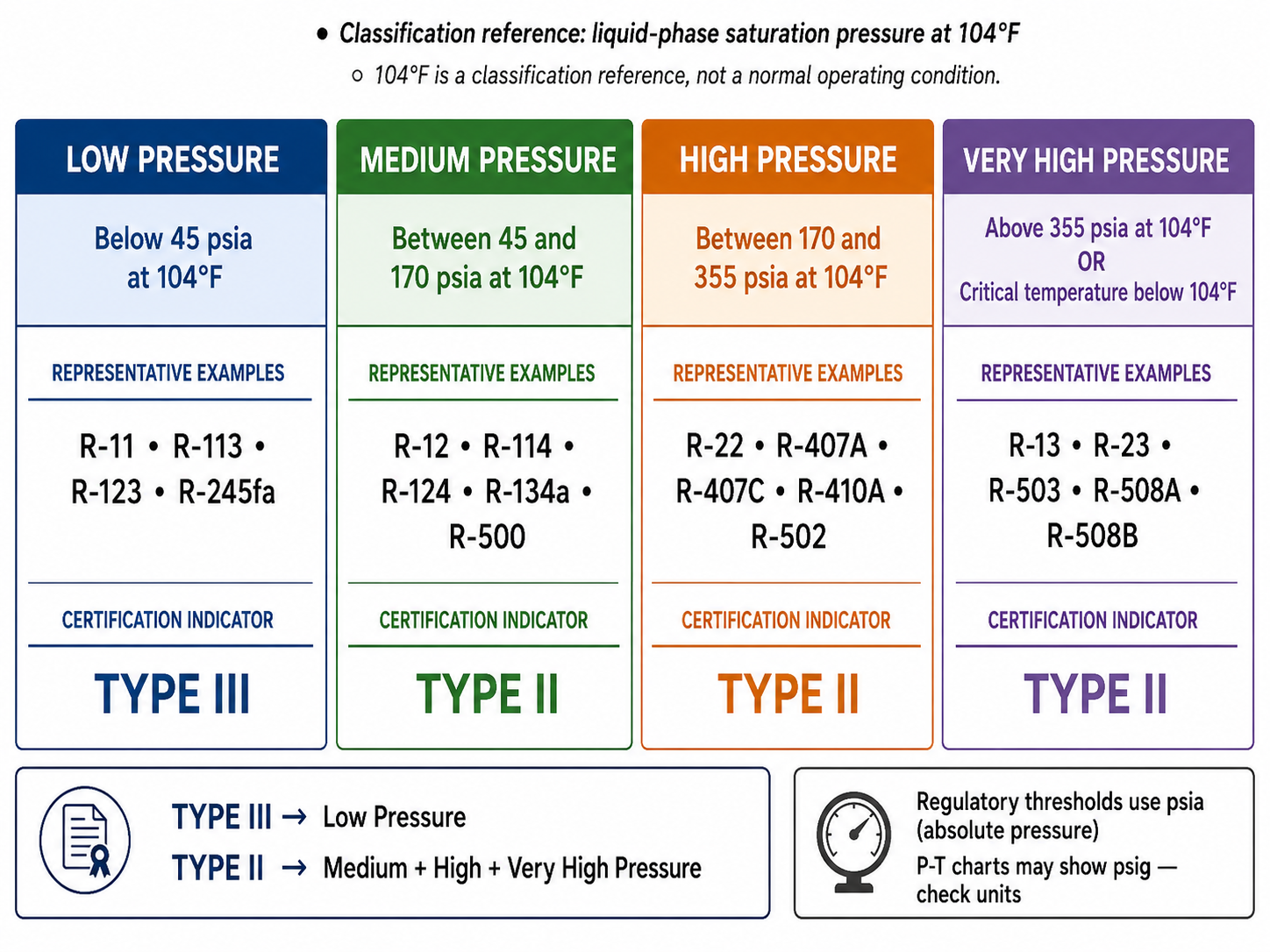
Figure 8.2.1 - Current Section 608 refrigerant pressure classifications and their certification relationship.
AI-generated instructional figure: It may contain visual inaccuracies. Use the accompanying lesson text and cited authoritative sources to verify technical and regulatory details.
EPA 608 Exam Focus
What Students Must Remember
- Current Section 608 definitions use four appliance pressure categories: low, medium, high, and very high.
- The categories are based principally on the refrigerant’s liquid-phase saturation pressure at .
- Very-high-pressure appliances also include refrigerants with a critical temperature below .
- Regulatory pressure thresholds are stated in psia.
- A standard service gauge normally displays psig.
- Near standard atmospheric conditions, approximately 14.7 psi separates psia and psig.
- Low pressure → Type III.
- Medium pressure → Type II.
- High pressure → Type II.
- Very high pressure → Type II.
- R-123 is a representative low-pressure refrigerant.
- R-134a is a representative medium-pressure refrigerant.
- R-22 and R-410A are representative high-pressure refrigerants.
- R-23 is a representative very-high-pressure refrigerant.
- R-410A is not classified as very high pressure merely because its field operating pressure is high.
- Operating suction and discharge pressures do not determine the EPA pressure category.
- A nameplate’s design pressure or test pressure is not the regulatory saturation-pressure classification value.
- The public label
Type 2 (High-Pressure)is shorthand; current regulatory Type II scope includes medium-, high-, and very-high-pressure appliances. - Older study material may use obsolete pressure-category terminology; current definitions control.
High-Priority Classification Table
| Exam Clue | Correct Classification Direction |
|---|---|
| R-123 appliance | Low pressure → Type III |
| R-134a appliance, when not Type I/MVAC | Medium pressure → Type II |
| R-22 appliance, when not Type I/MVAC | High pressure → Type II |
| R-410A stationary split system | High pressure → Type II |
| R-23 appliance | Very high pressure → Type II |
| Pressure threshold given in psia but P-T chart in psig | Convert/check units before comparison |
| High suction pressure caused by load | Does not redefine appliance pressure category |
| Nameplate shows a high design pressure | Does not by itself establish EPA high-pressure classification |
| Factory-sealed small appliance with ≤5 lb | Apply Type I definition before pressure-category shortcut |
Typical Exam Question Patterns
Students may be asked to:
- Identify a refrigerant as low, medium, high, or very high pressure.
- Match a refrigerant example to Type II or Type III.
- Recognize that medium-pressure appliances fall under Type II.
- Identify R-410A as high pressure rather than very high pressure.
- Identify R-134a as medium pressure.
- Identify R-123 as low pressure.
- Identify R-23 as very high pressure.
- Recognize the classification reference.
- Distinguish psia from psig.
- Convert a P-T chart pressure from psig to approximate psia.
- Distinguish EPA appliance pressure classification from refrigeration-cycle high-side/low-side terminology.
- Determine why a nameplate refrigerant designation matters more than one operating pressure reading.
- Reject outdated terminology from an older question or study guide.
High-Risk Words
Pay particular attention to:
- Absolute
- Gauge
- At
- Critical temperature
- Below
- Between
- Above
- Type II
- Type III
- Not
- Except
Common Mistakes and Confusing Points
Mistake 1: Treating Type II as Only the Current High-Pressure Range
Current Type II certification includes medium-, high-, and very-high-pressure appliances within the Type II scope.
Mistake 2: Calling R-410A a Very-High-Pressure Refrigerant
R-410A has high field operating pressures compared with R-22, but the current Section 608 definition lists it as a high-pressure refrigerant.
Mistake 3: Forgetting Medium Pressure
R-134a is a representative medium-pressure refrigerant, and medium-pressure appliances are included under Type II certification when the other Type II conditions are met.
Mistake 4: Comparing psig Directly With a psia Threshold
Check units. A pressure-temperature chart may use psig while the regulatory definition uses psia.
Mistake 5: Using Suction Pressure to Classify the Appliance
Suction pressure changes with load and operating conditions. It does not define the EPA pressure category.
Mistake 6: Using Head Pressure to Classify the Appliance
Discharge/head pressure also varies with operating conditions. The classification is based on refrigerant properties at the defined reference condition.
Mistake 7: Confusing High Side With High-Pressure Appliance
A high-pressure appliance has a high side and a low side. These are different uses of the word high.
Mistake 8: Using Nameplate Design Pressure as the Regulatory Threshold
Design/test pressures are equipment ratings, not the saturation-pressure value used in the Section 608 definition.
Mistake 9: Assuming Refrigerant Family Determines Pressure Category
CFC, HCFC, HFC, HFO, hydrocarbon, and other chemical-family labels do not determine low-, medium-, high-, or very-high-pressure classification.
Mistake 10: Applying Pressure Classification Before Checking the Small-Appliance Definition
A small appliance remains Type I for maintenance, service, and repair when it satisfies the complete small-appliance definition.
Mistake 11: Treating as a Required Operating Temperature
It is a regulatory reference condition for classification, not a normal operating setpoint.
Mistake 12: Memorizing Legacy Category Names
Older study material may use historical terminology. For current classification questions, use the current 40 CFR § 82.152 definitions.
Concept-Check Questions
Question 8.2-1
Which statement best describes the current Section 608 definition of a high-pressure appliance?
A. It is any appliance whose discharge gauge exceeds 170 psig during operation.
B. It uses a refrigerant with a liquid-phase saturation pressure between 170 psia and 355 psia at .
C. It is any appliance containing more than 50 lb of refrigerant.
D. It is any appliance using R-134a.
Question 8.2-2
Which refrigerant is identified by the current regulation as a representative medium-pressure refrigerant?
A. R-123
B. R-134a
C. R-410A
D. R-23
Question 8.2-3
Which refrigerant is identified as a representative high-pressure refrigerant under the current Section 608 definition?
A. R-123
B. R-134a
C. R-410A
D. R-23
Question 8.2-4
Which condition can independently place a refrigerant in the very-high-pressure category?
A. A critical temperature below
B. A suction pressure below atmospheric pressure
C. A discharge line temperature above
D. A factory charge above 5 lb
Question 8.2-5
A pressure-temperature chart lists pressure in psig, but a regulatory threshold is given in psia. What should the technician do before comparing the values?
A. Treat the units as identical.
B. Subtract the refrigerant charge from the pressure.
C. Account for atmospheric pressure so the units are consistent.
D. Use only the compressor discharge temperature.
Question 8.2-6
Which statement correctly distinguishes refrigeration-cycle pressure terminology from EPA appliance classification?
A. A low-pressure appliance has no high side.
B. A high-pressure appliance has no low side.
C. High side and low side describe regions of the operating cycle, while EPA pressure categories classify appliances by refrigerant properties.
D. The two sets of terms are interchangeable.
Question 8.2-7
A factory-manufactured, factory-charged, factory-hermetically-sealed appliance contains 4 lb of a refrigerant that falls within a high-pressure refrigerant category. Which question must be answered before automatically selecting Type II?
A. Does the appliance satisfy the complete Type I small-appliance definition?
B. Is the suction pressure above 45 psig?
C. Is the cabinet physically large?
D. Does the compressor use mineral oil?
Question 8.2-8
Which statement about the common label Type 2 (High-Pressure) is most accurate?
A. It means medium-pressure appliances are Type III.
B. It is useful shorthand, but the current certification regulation includes medium-, high-, and very-high-pressure appliances under Type II.
C. It means very-high-pressure appliances require a separate Type IV certification.
D. It applies only to R-22 appliances.
Answers and detailed explanations will be provided in
8.15 - Answers and Explanations.md.
Section Summary
EPA Section 608 appliance pressure classification uses refrigerant properties rather than one momentary operating pressure reading.
The current categories are:
- Low pressure: liquid-phase saturation pressure below at → Type III.
- Medium pressure: liquid-phase saturation pressure between and at → Type II.
- High pressure: liquid-phase saturation pressure between and at → Type II.
- Very high pressure: critical temperature below or liquid-phase saturation pressure above at → Type II.
Representative current examples include:
- R-123 → low pressure.
- R-134a → medium pressure.
- R-22 and R-410A → high pressure.
- R-23 → very high pressure.
The regulatory thresholds use psia, while HVAC service gauges commonly use psig. The student must check units before using a pressure-temperature chart for a regulatory comparison.
Pressure classification must also remain separate from:
- Operating high side and low side.
- Equipment design pressure.
- Refrigerant safety class.
- Refrigerant chemical family.
- Physical equipment size.
The next section develops the major Type II components, refrigerant states, access points, and isolation features that become important during recovery and service.
References
Current Regulatory Sources
-
U.S. Environmental Protection Agency, Section 608 Test Topics, accessed August 12, 2026.
-
U.S. Environmental Protection Agency, Section 608 Technician Certification Requirements, accessed August 12, 2026.
-
U.S. Environmental Protection Agency, Section 608 Technician Certification, accessed August 12, 2026.
-
Electronic Code of Federal Regulations, 40 CFR § 82.152 - Definitions, accessed August 12, 2026.
-
Electronic Code of Federal Regulations, 40 CFR § 82.161 - Technician Certification, accessed August 12, 2026.